Republish: ctrlvee: extract external R code and insert it inline
Do you want to share your content on R-bloggers? click here if you have a blog, or here if you don’t.
Republished from the original at https://blog.stephenturner.us/p/ctrlvee-extract-external-r-code-insert-inline-positron-rstudio-addin.
Have you ever found yourself scrolling through a pkgdown page or Quarto book, copying and pasting bits of code from your browser into your IDE? Yes, and it’s a minor inconvenience.
My friend and colleague VP Nagraj released a new R package called ctrlvee it makes things much easier.
It does one thing. Place your cursor anywhere in an R script in Positron or RStudio, call the add-in, provide a URL and a few milliseconds later you will have all the code for that page in your editor, separated by chunk boundaries (with some metadata and a note to check the license!).
The README package provides a demonstration using the “Data Validation and Quality Assurance” chapter of my Data Science Team Training book (dstt.stephenturner.us).
-
Install the package:
install.packages("ctrlvee") -
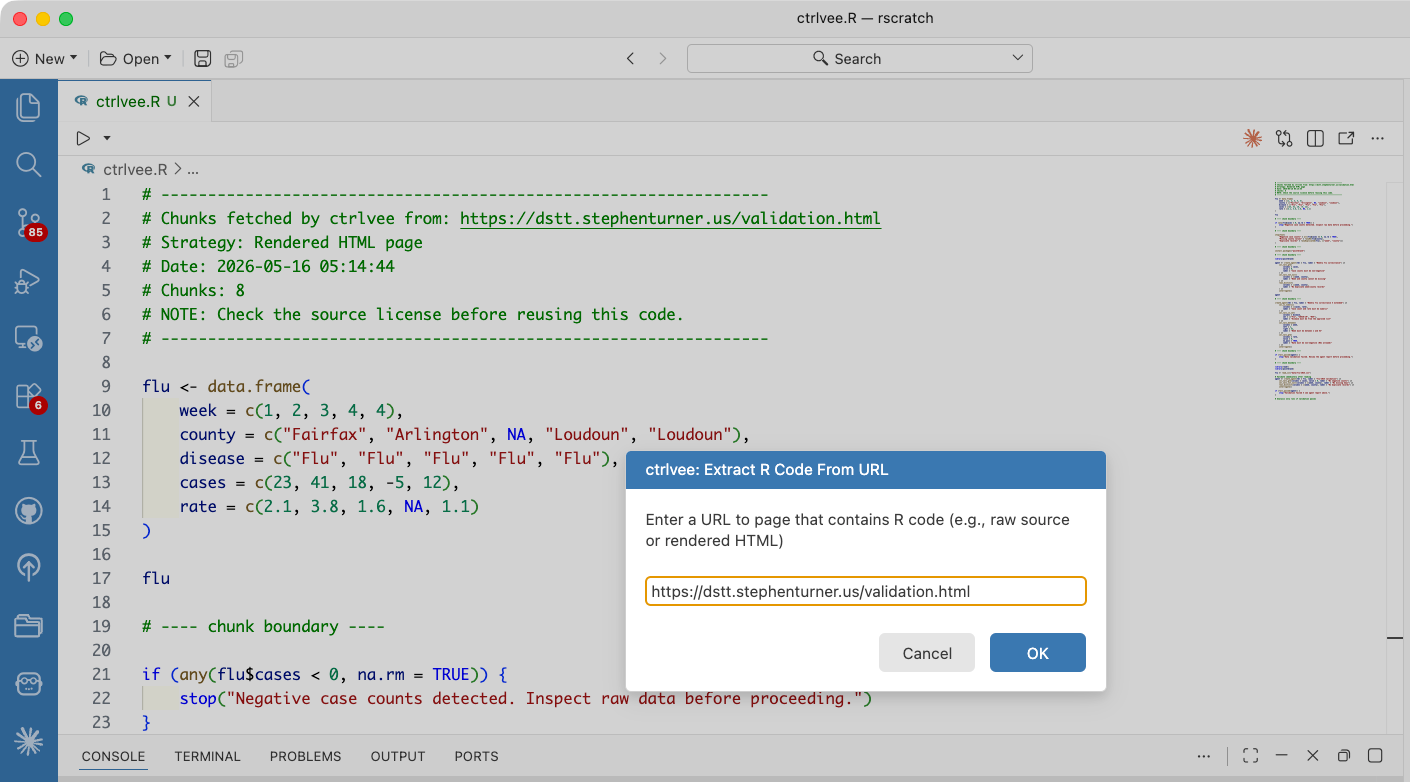
Run the add-in. In Positron, you will open the Command Palette, search for Run RStudio Addin, then extract external R code and insert it inline. You will receive a modal asking for a URL.
-
Stick one. For example,
-
The R code of the site appears in your editor 🚀
Here is a demo.
This is what the extracted/inserted code looks like, from this source.
# -----------------------------------------------------------------
# Chunks fetched by ctrlvee from:
# Strategy: Rendered HTML page
# Date: 2026-05-16 05:14:44
# Chunks: 8
# NOTE: Check the source license before reusing this code.
# -----------------------------------------------------------------

flu <- data.frame(
    week = c(1, 2, 3, 4, 4),
    county = c("Fairfax", "Arlington", NA, "Loudoun", "Loudoun"),
    disease = c("Flu", "Flu", "Flu", "Flu", "Flu"),
    cases = c(23, 41, 18, -5, 12),
    rate = c(2.1, 3.8, 1.6, NA, 1.1)
)

flu

# ---- chunk boundary ----

if (any(flu$cases < 0, na.rm = TRUE))
    stop("Negative case counts detected. Inspect raw data before proceeding.")


# ---- chunk boundary ----

stopifnot(
    "Negative case counts" = all(flu$cases >= 0, na.rm = TRUE),
    "Missing county values" = !anyNA(flu$county),
    "Duplicate records" = !anyDuplicated(flu[, c("week", "county")])
)

# ---- chunk boundary ----

install.packages("pointblank")

# ---- chunk boundary ----

library(pointblank)

agent <- create_agent(tbl = flu, label = "Weekly flu surveillance") |>
    col_vals_gte(
        columns = cases,
        value = 0,
        label = "Case counts must be non-negative"
    ) |>
    col_vals_not_null(
        columns = c(week, county),
        label = "Week and county cannot be missing"
    ) |>
    rows_distinct(
        columns = c(week, county),
        label = "No duplicate week/county records"
    ) |>
    interrogate()

agent

# ---- chunk boundary ----

create_agent(tbl = flu, label = "Weekly flu surveillance — extended") |>
    col_is_numeric(
        columns = c(cases, rate),
        label = "Case count and rate must be numeric"
    ) |>
    col_vals_in_set(
        columns = disease,
        set = c("Flu", "COVID-19", "RSV"),
        label = "Disease must be from the approved list"
    ) |>
    col_vals_between(
        columns = week,
        left = 1,
        right = 52,
        label = "Week must be between 1 and 52"
    ) |>
    col_vals_gte(
        columns = rate,
        value = 0,
        na_pass = TRUE,
        label = "Rate must be non-negative (NAs allowed)"
    ) |>
    interrogate()

# ---- chunk boundary ----

if (!all_passed(agent))
    stop("Data validation failed. Review the agent report before proceeding.")


# ---- chunk boundary ----

library(readr)
library(pointblank)

flu <- read_csv("data/flu-2024.csv")

# Validate immediately after reading
agent <- create_agent(tbl = flu, label = "flu-2024 validation") |>
    col_vals_gte(columns = cases, value = 0, label = "No negative counts") |>
    col_vals_not_null(columns = c(week, county), label = "No missing keys") |>
    rows_distinct(columns = c(week, county), label = "No duplicate records") |>
    interrogate()

if (!all_passed(agent))
    stop("Validation failed — see agent report above.")
Related
PakarPBN
A Private Blog Network (PBN) is a collection of websites that are controlled by a single individual or organization and used primarily to build backlinks to a “money site” in order to influence its ranking in search engines such as Google. The core idea behind a PBN is based on the importance of backlinks in Google’s ranking algorithm. Since Google views backlinks as signals of authority and trust, some website owners attempt to artificially create these signals through a controlled network of sites.
In a typical PBN setup, the owner acquires expired or aged domains that already have existing authority, backlinks, and history. These domains are rebuilt with new content and hosted separately, often using different IP addresses, hosting providers, themes, and ownership details to make them appear unrelated. Within the content published on these sites, links are strategically placed that point to the main website the owner wants to rank higher. By doing this, the owner attempts to pass link equity (also known as “link juice”) from the PBN sites to the target website.
The purpose of a PBN is to give the impression that the target website is naturally earning links from multiple independent sources. If done effectively, this can temporarily improve keyword rankings, increase organic visibility, and drive more traffic from search results.