How PMs Misinterpreted Acquisition Peaks (and What to Measure Instead)
When you introduce a new feature, you probably notice that your product count increases almost immediately. Your registrations double, traffic increases, and dashboards start glowing with positive indicators. For a moment, everything points to success.
But after a few weeks, your customers’ enthusiasm fades. Daily active users are stagnating. You notice that retention is decreasing faster than expected.
Additionally, the majority of new users do not return after their first engagement. What seemed like growth is actually something completely different. I’m sure you’ve seen this problem before.
Teams typically associate acquisition with progress, assuming that more users equals a more powerful product. However, growth itself is only an imperfect indicator. It shows you how many people showed up, not whether they found value or chose to continue using the product.
Understanding where this misconception comes from and how to fix it is essential for anyone looking to create something that will last. Keep reading to learn why you should stop paying so much attention to acquisition peaks and what you should be measuring instead.
How teams misinterpreted growth metrics
Most product teams rely primarily on acquisition metrics to determine success. These can include registrations, app installs, traffic, and campaign conversion rates. They are simple to evaluate, explain and are often linked to growth objectives.
At their core, acquisition metrics measure interest rather than outcomes. A listing only indicates that the user was curious enough to try the product. This curiosity can come from a variety of sources, including marketing initiatives, social discussions, prompts, or even accidental clicks. This does not necessarily indicate a real need for the product.
This creates a subtle but dangerous illusion. When the number of acquisitions increases, teams believe the product is better. In fact, they may be getting better at getting attention.
A more precise approach to thinking about this is to separate intent from value:
- The acquisition demonstrates the intention — Users appearing
- Retention demonstrates value — Users choose to stay
If retention does not follow acquisition, growth fails to generate meaningful progress. Without this distinction, teams risk touting metrics that have little impact on long-term success.
What “Shoddy Growth” Really Looks Like
Not all growth is equally beneficial to the success of a product. Some users become long-term committed customers. Others leave almost as soon as they arrive.
The distinction lies in the quality of growth. Low-quality growth can appear powerful on the surface, but be flawed when user behavior is examined more deeply.
A common trend is high acquisition followed by low activation. Users sign up in significant numbers but don’t take the crucial actions that establish the value of the product. This usually indicates that either the onboarding process is unclear or the product is not quickly expressing why it is important.
Another trend is that of high initial usage followed by a sharp decline. Users participate in their first session, usually motivated by curiosity or external factors, but never return. This indicates that the product has not provided a compelling reason to continue using it.
In some cases, growth is driven solely by incentives. Referral programs, discounts, and prizes can attract large numbers of users, but they are often driven by incentive rather than the product itself. When the reward disappears, their commitment fades.
There is also the issue of superficial engagement. Users can briefly interact with the product by clicking on features or exploring the interface, but never use its main functionality. This type of action can exaggerate engagement metrics while obscuring true value.
Vanity Metrics vs. Product Signals
To make sense of growth, you need to differentiate between vanity metrics and product signals.
Vanity metrics are data that looks spectacular but gives no insight into how the product actually works. This category includes total registrations, page views and downloads. These metrics assess visibility and reach, but they don’t reveal whether users find value in them.
Product signals, on the other hand, are metrics that capture actual user results. They demonstrate whether users are actively engaging with the product and whether this engagement is maintained over time.
Activation rate is one of the most important product signals. It calculates the percentage of users who perform a critical activity that reflects the value of the product. If users aren’t activating, it means the acquisition isn’t resulting in substantial usage.
Retention is even more important. It allows you to know if users return after their first contact. High retention suggests the product solves a real problem. Low retention indicates that users either did not find value or found insufficient value to return.
The main difference between these two categories is simple: vanity metrics tell you how many people you’ve reached, while product signals tell you how many people you’ve actually helped.
Diagnosing the problem: where growth collapses
When growth doesn’t translate into retention, the problem is usually product experience rather than acquisition strategy.
One of the most common problems is a slow or delayed “aha moment.” This is when users realize the value of the product. If this moment is difficult to achieve or poorly articulated, users are unlikely to stick around long enough to experience it.
Incentives can also affect growth. Although they can be useful for a short-term acquisition, they generally attract users more concerned with the reward than the product itself. This leads to a gap between user behavior and product value.
Finally, effective onboarding is essential. Even if users agree, a complex or stressful onboarding process may prevent them from using the product effectively. Retention problems are often disguised as integration problems.
What PMs should measure instead
To move beyond misleading growth metrics, you need to prioritize metrics that represent real user behavior. Here are the five things I recommend looking out for:
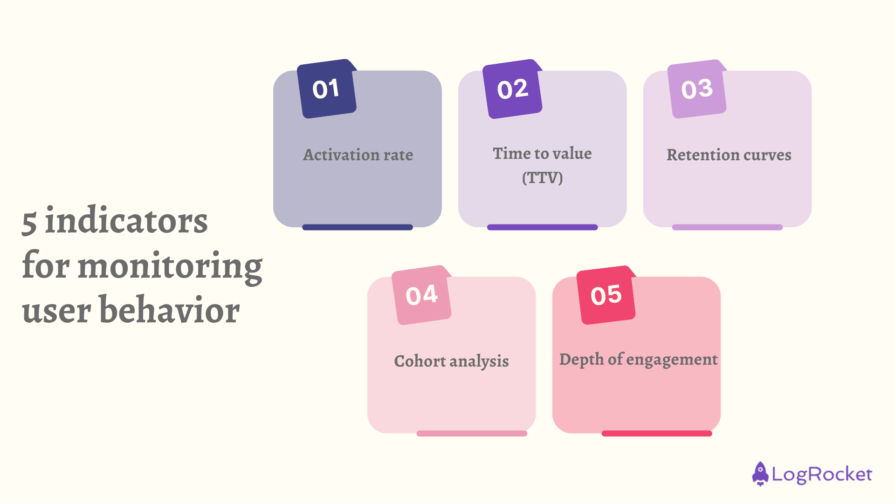
1. Activation rate
This is the basis for the success of the product. If users don’t activate, nothing else matters.
To improve activation:
- Identify the key action that represents value
- Remove friction from the onboarding process
- Guide users to this action
2. Valuation period (TTV)
The sooner users discover value, the more likely they are to stay.
Reducing TTV involves:
- Simplify integration
- Highlighting key features
- Remove unnecessary steps
3. Retention curves
Retention curves explain how user engagement varies over time.
A strong product generally has:
- A constant decline followed by stabilization
A weak product usually shows:
- A sharp decline without any recovery
4. Cohort analysis
Cohort analysis groups users based on when and how they joined.
This helps answer:
- Which acquisition channels generate the most users?
- Do specific features increase retention?
5. Depth of Engagement
Instead of just measuring activity, measure meaningful activity:
- Are users benefiting from basic functionality?
- Are they completing important tasks?
Moving from acquisition to retention
Shifting from acquisition-focused thinking to retention-focused thinking requires a fundamental shift in the way product teams work.
The first step is to validate the product before scaling for growth. If users don’t activate or retain, increased acquisitions will only make the problem worse. Growth should happen after, not before, product validation.
Then, growth strategies must be consistent with the primary value of the product. The goal is not just to attract users, but to attract the right users, those who will benefit the most from the product.
The initial user experience must also be properly optimized. Retention can often be determined from the first session, so clarity, simplicity and immediate value are key.
Finally, every growth initiative should be evaluated based on what happens after registration. It is not enough to count the number of users acquired. Teams need to understand how these users interact, whether they activate or return.
Final Thoughts
Growth is not necessarily misleading, but it is often misinterpreted. Acquisition metrics are useful, but they are only the beginning of the story.
What happens after users arrive determines the true success of the product. You need your users to discover the value, come back and make the product part of their habit.
This means shifting the focus of your work from attracting users to retaining them. As a final tip, remember that long-term growth is based on compounding and constant value.
Do you have a story of a time when you misinterpreted an acquisition spike? Let us know in the comments below.
Featured Image Source: IconScout
LogRocket generates product insights that drive meaningful actions

LogRocket identifies friction points in the user experience so you can make informed decisions about what product and design changes need to be made to achieve your goals.
With LogRocket, you can understand the extent of issues affecting your product and prioritize changes. LogRocket simplifies workflows by allowing engineering, product, user experience, and design teams to work from the same data as you, eliminating confusion about what needs to be done.
Get your teams on the same page – try LogRocket today.
PakarPBN
A Private Blog Network (PBN) is a collection of websites that are controlled by a single individual or organization and used primarily to build backlinks to a “money site” in order to influence its ranking in search engines such as Google. The core idea behind a PBN is based on the importance of backlinks in Google’s ranking algorithm. Since Google views backlinks as signals of authority and trust, some website owners attempt to artificially create these signals through a controlled network of sites.
In a typical PBN setup, the owner acquires expired or aged domains that already have existing authority, backlinks, and history. These domains are rebuilt with new content and hosted separately, often using different IP addresses, hosting providers, themes, and ownership details to make them appear unrelated. Within the content published on these sites, links are strategically placed that point to the main website the owner wants to rank higher. By doing this, the owner attempts to pass link equity (also known as “link juice”) from the PBN sites to the target website.
The purpose of a PBN is to give the impression that the target website is naturally earning links from multiple independent sources. If done effectively, this can temporarily improve keyword rankings, increase organic visibility, and drive more traffic from search results.